


20 Shopify SEO Tips to Bring More Qualified Buyers to Your Store


Oct 26, 2026

Contents
 15 min
- The four gates to better Shopify SEO
- Why businesses need Shopify SEO
- What Shopify handles and what your team must own
- Implementation process for better SEO for your Shopify website
- Which Shopify SEO tools do you actually need
- A 90-day implementation plan
- Measure revenue without confusing it with traffic


The best Shopify SEO tips start with the page that should earn the sale. Make that page easy to find, useful to the buyer and clear about the product. Then fix the technical issues that stop search engines from reaching it.
This guide is for founders, ecommerce directors, and marketing leaders who need more than organic traffic. You may need first orders, profitable repeat purchases, or qualified wholesale inquiries. Those goals change which pages deserve attention first.
My recommendation is to work through four gates: discovery, relevance, confidence, and revenue. Start with blocked revenue pages, improve a small group of key collections and products, and then expand what the evidence supports.
The four gates to better Shopify SEO
|
Gate |
What to check |
Business question |
|---|---|---|
|
Discovery |
Indexing, links, canonicals, and crawl access |
Can search engines reach the right page? |
|
Relevance |
Search intent, collection structure, and product detail |
Does this page answer the buyer query? |
|
Confidence |
Mobile use, speed, evidence, and store policies |
Can the buyer choose without extra doubt? |
|
Revenue |
Orders, margin, qualified inquiries, and repeat buying |
Is the traffic contributing to the business? |
A failed gate gives you a priority. If a product page is excluded from search, fix discovery. If it gets clicks but few purchases, inspect the offer, audience, and buying experience before commissioning more articles.
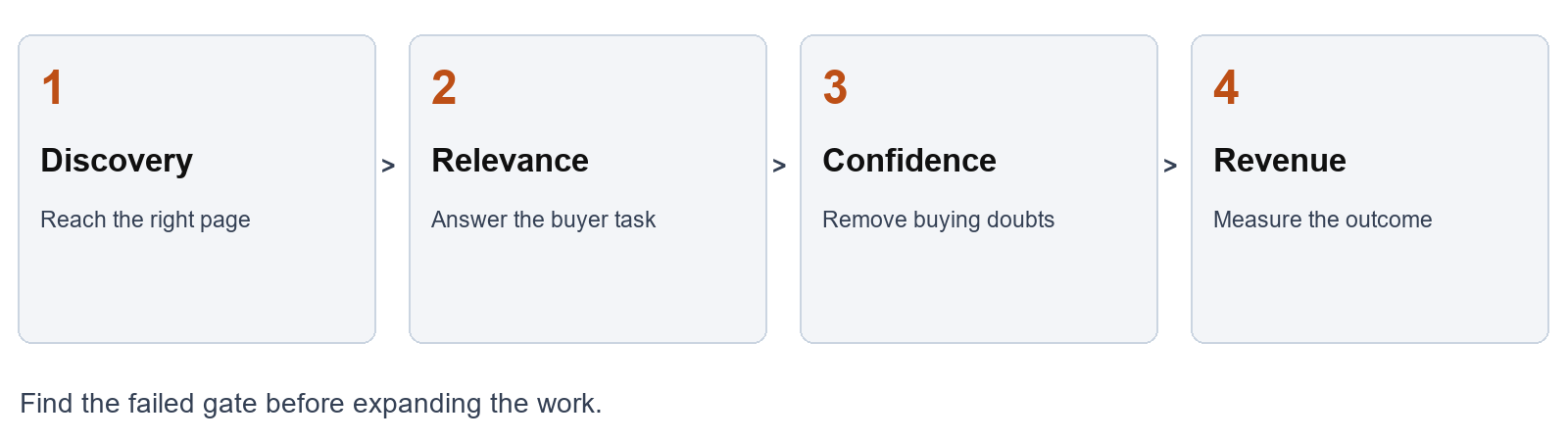
Use the gates in order to choose the next SEO task.
Why businesses need Shopify SEO
Shopify gives you a storefront. SEO helps a buyer find the right part of it when they search for a product, a category, or an answer. That matters when paid clicks stop as soon as the budget stops, or when buyers research before returning through another channel.
The aim is not to replace paid marketing. Use search to build useful pages and a more durable source of demand. Paid campaigns can help test an offer while organic pages develop. Compare their business contribution using a consistent attribution model.
For a direct-to-consumer brand, that contribution may be new-customer orders. For an equipment supplier, it may be a qualified quote request followed by a sale in the CRM. A clinic selling approved skincare products may need product orders and separate appointment tracking. One traffic target will not describe all three.
SEO also has a cost. Include research, development, content and maintenance when judging returns. The practical question is which pages can attract relevant demand and convert it at sustainable economics.
What Shopify handles and what your team must own
Shopify supplies foundations such as generated sitemaps, HTTPS and default technical settings. Themes and apps affect the final output. Review your live store instead of assuming every default remains correct after customization. Shopify explains its platform foundations in its SEO overview.
Your team still owns the query strategy, product facts, collection design, internal links and performance checks. Shopify cannot know which category has the best margin or which buyer needs a technical spec before ordering.
1. Measure organic orders before editing pages
Connect Google Search Console and GA4. Follow Shopify's current Google Analytics setup through the supported Google and YouTube channel flow. Avoid adding a second purchase tag that counts the same order twice.
Test a purchase. Check the transaction ID, currency and value against Shopify. Decide how refunds, consent and attribution affect the reports. For B2B, test a quote submission and trace it into the CRM.
Add Bing Webmaster Tools if Bing discovery matters to your audience. Save a baseline by landing page, device and country. Separate branded searches from category demand. A rise in people searching your brand can look like an SEO improvement even when category visibility has not changed.
Check success: A leader can trace an organic landing page to an order or a qualified inquiry, with known reporting limits.
2. Confirm the domain sitemap and index access
Use a branded primary domain and confirm HTTPS works. A custom domain supports a consistent brand identity; it is not an automatic ranking boost.
Open /sitemap.xml and submit it in Search Console. Shopify generates this file, so you normally do not need an app to build it. A sitemap helps discovery but does not force Google to index every listed page. See Shopify's sitemap instructions.
Inspect sample product and collection URLs. Check the selected canonical, indexing status and whether the live page can be fetched. Confirm that a storefront password or a test noindex rule has not survived launch.
Why is my Shopify store not showing on Google? First separate a discovery problem from a ranking problem. A new indexed page can still rank poorly. Repeated sitemap submissions do not resolve weak content or a stronger competing result.
3. Match US keywords to the right page type
Set keyword research tools to the United States. Use actual US search results to judge intent, then validate opportunities against the products and inventory you can sell.
A query such as “fragrance free facial moisturizer” may suit a collection. A specific product and size belongs on its product page. “How to choose a moisturizer for dry skin” calls for a guide that helps the reader choose.
I would build a query-to-page map before writing. Record the main query, buyer task, destination page, current clicks and commercial value. Use site-search terms, support questions and marketplace suggestions to find customer language, then validate it against US Google intent. Group close variants when one page can answer them well. Do not create near-identical pages just to target singular and plural terms.
Keyword volume is an estimate, not a sales forecast. A low-volume replacement-part query can be more valuable than a broad lifestyle topic if it matches stock and buying intent.
4. Build collections around how customers shop
Use a clear hierarchy from the homepage to collections and products. Make key collections reachable through navigation and relevant content. Descriptive links help buyers understand where they are going.
Organize a skincare catalog by a useful product type or supported need. Organize industrial supplies by application, compatibility or part family. Avoid making every tag an indexable collection.
Give a collection a short introduction, useful selection criteria and a sensible product order. Add answers to purchase questions without pushing the product grid far down the page. Shopify's site structure guidance is a useful implementation reference.
Should I optimize collections or products first? Start where the relevant query lands. Category searches need a useful collection; exact-model searches need a complete product page. Prioritize stock, margin and demand rather than always choosing one type.
5. Write product pages that resolve purchase doubts
Go beyond the manufacturer's paragraph. Explain what the item does, who it suits and what a buyer needs to know before ordering. Use accurate dimensions, materials, compatibility, pack quantities, care instructions and delivery details.
For a B2B catalog, add specs, units and a route to ask a technical question. Keep sensitive negotiated pricing private while making useful public product details available.
A 50 mL skincare product needs its actual ingredients and directions. A replacement filter needs its supported model numbers and replacement schedule. Do not add health claims, certifications or compatibility claims that the business cannot support.
Check success: The page answers recurring presale questions. Track changes in add-to-cart behavior, purchases and returns, not merely the number of words added.
6. Improve titles headings and meta descriptions
Give each key page a clear title and main heading. Name the product or collection in language buyers use. Use a meta description to explain the selection or value, without promises the page cannot fulfill.
Before: Premium Products | Shop Now
After: Fragrance Free Face Moisturizers | Brand
Description example: Compare fragrance-free face moisturizers by texture, size and ingredients. Check current stock status and US delivery options.
Google can generate different title links and snippets. Its title guidance and snippet guidance do not establish a universal character count that guarantees display. Use length previews as editing aids. Write for the actual page rather than filling the snippet with query variations.
7. Keep URLs clear and protect existing destinations
Use readable handles such as /collections/fragrance-free-moisturizers. Shopify has fixed route patterns such as /products/ and /collections/. Do not redesign the entire platform to remove a folder for an assumed SEO gain.
Leave a useful, established URL alone unless there is a business reason to change it. If a URL changes, map the old destination to the closest valid replacement, update internal links and test the redirect.
Shopify's native redirect rules have restrictions, including that a redirect does not replace a URL still serving a valid page. Test the live response rather than assuming a saved redirect works.
8. Review canonical URLs and product variants
A product can be reachable through a collection path as well as its main product URL. Check the live canonical tag, internal links and Google's selected canonical before calling this a duplicate-content failure.
An alternate URL with a proper canonical is not automatically an error. A canonical is a signal, not a command. Keep product URLs, sitemaps and internal links consistent where practical.
Variants need a deliberate policy. A color or pack size does not always need a separate indexable page. Separate products may make sense when buyer intent, stock or specs differ enough to justify them. Use Google's ecommerce URL guidance when planning the structure.
9. Control filter URLs without hiding useful products
Filters help buyers, but combinations of size, color, sort order and price can produce many low-value URLs. Decide which filtered views deserve a stable landing page and which should remain navigation aids.
Google describes the crawl risk in its faceted navigation guidance. Do not make broad robots.txt changes without testing the effect on product discovery. Blocking a URL from crawling is not the same as removing it from the index.
Check that key product details and links appear in the rendered page, not only after an interaction Google may not perform. Check pagination too. Buyers and crawlers need a path to products beyond the first screen. An infinite-scroll interface needs accessible page links or another crawlable implementation. Follow Google's pagination guidance.
10. Fix slow mobile templates before adding more apps
Test the homepage, a key collection and several product pages on mobile. Review real-user data where available alongside lab tests. A single desktop performance score cannot describe the whole store.
Google's current good Core Web Vitals thresholds are LCP at or below 2.5 seconds, INP at or below 200 milliseconds and CLS at or below 0.1, assessed at the 75th percentile. These measure loading, response and visual stability. They are not a guarantee of ranking.
Inspect oversized hero media, autoplay video, review widgets and scripts left by apps. Change one expensive component, then retest the buying path. Do not lazy-load the main above-the-fold product image by default.
A published Rakuten 24 performance case study reported a 33.13% conversion-rate gain in its test. This older Japanese ecommerce example is not a Shopify or US-store forecast. It supports testing speed against business outcomes rather than treating speed as a cosmetic score.
11. Make images useful for shoppers and search
Use clear product photos, relevant close-ups and dimensions that suit the layout. Compress files without making labels or detail unreadable. Give new files sensible names.
Write alt text that explains the image. “Replacement filter showing the inlet connector” is useful. A string of “best cheap filter buy online” is not. Decorative images should not burden screen readers with keyword lists.
Add short videos when fit, assembly or use is hard to explain. Keep key facts in text as well. A video should answer a buying question, not slow every page to decorate the store.
12. Validate product structured data
Structured data helps search engines interpret product facts. Inspect what the theme and apps already produce before adding another schema app.
Check price, currency, stock status and product identifiers against visible content. Use genuine reviews and applicable variant details. Run the live page through Google's Rich Results Test and inspect Search Console reports.
Google's product structured data documentation explains product snippets and merchant listings. Valid markup can support eligibility; it does not guarantee an enhanced result.
Do I need FAQ schema on every page? No. Publish answers because buyers need them. Do not promise FAQ rich results for a typical ecommerce store, and do not mark up invented reviews.
13. Connect Merchant Center and keep the feed accurate
Product discovery extends beyond standard blue links. Connect the right Google channel and review Merchant Center diagnostics. Keep the landing page, feed and checkout aligned on price, currency, stock status and shipping terms.
Use legitimate product identifiers where available. Resolve disapprovals instead of assuming all published products are eligible. Google's free listings guidance describes eligible product appearances across its surfaces.
Are Google Shopping and Shopify SEO the same? No. Feed-driven listings, paid Shopping campaigns and organic web results have different controls and reports. Coordinate the product data, but measure the channels separately.
14. Publish buying guides that lead to useful next steps
Write about questions customers ask before choosing. “Which connector fits this device” can be more useful than a broad trend article. Link to the relevant collection or product where it helps the reader act.
Build a small cluster around a category. A commercial espresso supplier could explain machine capacity, grinder compatibility and routine maintenance. Each article should solve a different task rather than repeat the same keyword.
Use original photos, demonstrations and expert review where the topic calls for it. There is no universal minimum word count. I would rather publish one complete selection guide than several long pages that never answer the purchase question.
15. Earn relevant links and strengthen internal paths
Connect useful guides to collections, products and related answers with descriptive anchors. Fix orphaned priority pages. Do not link every phrase or point every article to the homepage.
For external links, offer something worth citing: a compatibility reference, product test with a stated method, installation guide or original supplier data. Seek relevant stockist and partner listings.
Guest contributions can introduce your expertise to a relevant audience. Avoid buying ranking links or mass guest-post packages. Paid placements need right treatment; they are not a shortcut to proven demand.
16. Handle out-of-stock and discontinued products deliberately
Keep a temporarily unavailable product page useful when it is likely to return. Show accurate stock status, expected timing if known and genuine alternatives. Offer a back-in-stock alert with suitable consent.
For a permanent removal, choose a close replacement only if it meets the same need. A genuine 404 or 410 can be right when there is no substitute. Do not redirect every discontinued item to the homepage.
Update links, feeds, and product data when stock changes. For seasonal collections, decide whether the page remains useful between seasons before deleting it each year.
17. Make trust and conversion part of the landing page
Buyers need to know who sells the product, how to contact the business and what happens after checkout. Keep About, Contact, shipping and returns details easy to reach.
Show accurate reviews and clear delivery expectations. For professional products, include suitable documentation or a technical contact. For health-related goods, have qualified reviewers check claims rather than dressing sales copy as medical advice.
Email capture can help people who are not ready to buy, but it is a conversion tactic, not an automatic ranking factor. Use a relevant offer and avoid a mobile popup that hides the product before the buyer can assess it.
18. Use local SEO only where the business qualifies
A real store, showroom or eligible service location may benefit from a Google Business Profile and useful location pages. Keep public details and opening hours accurate. Connect local product stock status where supported.
An online-only brand should not invent a storefront to appear on Maps. Google's business eligibility guidance excludes online-only businesses.
For a clinic with an attached Shopify shop, separate appointment intent from product-shopping intent. Local clinic pages can serve patients while the catalog serves product buyers. Do not send every local service query to a product collection.
19. Check the US buying experience in a multi market store
If the store serves several countries, confirm that US visitors see the correct prices, stock, shipping details and return terms. Use supported market settings and review language and regional signals with a developer.
A US page with an unexpected currency or unavailable shipping can attract the right click and lose the sale. Test the route from a search landing page to checkout, not just the homepage.
When migrating domains or changing market URLs, map old destinations and validate redirects. Follow Google's site move guidance. Monitor priority pages during the move instead of rewriting every URL and template at once.
20. Keep product details useful for AI discovery
AI-assisted shopping increases the value of clear product facts and selection criteria. Publish readable specs, comparisons, sizes and policies. Keep those facts consistent with your catalog and feed.
Shopify's AI store guidance recommends detailed product details and describes its Knowledge Base app for store FAQs. Review answers against real policies before expanding them.
Google says its AI search features do not require special additional optimization beyond established SEO practices. Prioritize accessible content and accurate data. No special file or schema guarantees a recommendation.
Use AI to draft from an approved product record, group queries or flag missing fields. Require human review for facts, claims and comparisons. Do not automate thousands of pages from minor keyword changes.
Implementation process for better SEO for your Shopify website
Start with your product margins and the buyer journey, then choose the pages to improve. Adapt the process to the way your customers research and buy.
1. Beauty wellness and consumer brands
Map collections to product type and supported use cases. Improve ingredient, size, routine and delivery details. Start with in-stock products that can support acquisition costs. Track new-customer orders, contribution margin and returns by landing page.
2. Healthcare practices with a product catalog
Separate consultation and appointment pages from products. Review health claims with the business's qualified subject expert. Connect product orders and appointment inquiries to different reports. Shopify SEO is relevant to the shop; it is not a substitute for the practice's local or clinical content strategy.
3. Manufacturers distributors and equipment suppliers
Prioritize part numbers, specs, compatibility and application-based collections. Keep useful catalog pages public where commercial policy allows, while protecting negotiated terms. Connect quote requests to the CRM and judge them by qualified opportunity and eventual revenue. Check current Shopify B2B plan capabilities before specifying features.
4. Retailers and sellers of home service products
Clarify local pickup, delivery and installation boundaries. Link a product to the service details a buyer needs. Measure orders and service inquiries separately. For HVAC parts, for example, a compatibility answer can be more valuable than a broad “home comfort” article.
Which Shopify SEO tools do you actually need
|
Job |
Starting tools |
When to add more |
|---|---|---|
|
Visibility and indexing |
Add reporting automation when manual review becomes costly. |
|
|
Sales measurement |
Shopify reports and GA4 |
Add CRM reporting for quotes and longer sales cycles. |
|
Performance and markup |
Add ongoing monitoring after template or app changes. |
|
|
Research and crawling |
A focused manual review |
Use Ahrefs or Semrush and a crawler such as Screaming Frog for larger catalogs. |
|
Catalog workflows |
Shopify product records and a controlled task list |
Add automation for stock, feed and missing-field alerts with review rules. |
Choose an app for a verified gap. A new SEO score does not prove that the app improved indexing or sales. Check duplicate schema, leftover scripts and the performance cost before installing another tool.
A 90-day implementation plan
Days 1 to 14: Verify measurement and audit a sample of high-value pages. Resolve access problems, major feed errors and broken buying paths. Save the baseline and change log.
Days 15 to 45: Improve a focused group of collections and products. Fix template issues, selection details, mobile speed and internal paths. Assign an owner and a validation check to each change.
Days 46 to 90: Publish supporting buying content and pursue relevant links. Expand the page group when early evidence supports it. Review results against seasonality, stock and promotions.
This is a delivery plan, not a promise of ranking gains within 90 days. Some fixes are visible quickly; competitive search growth and revenue evidence can take longer.
Measure revenue without confusing it with traffic
Review nonbrand search clicks, product discovery, qualified sessions and orders together. For B2B, add accepted inquiries and won revenue from the CRM. Explain what your chosen attribution model gives credit for.
Planning example: 5,000 qualified organic sessions at a 2% purchase rate and a $120 average order value would produce $12,000 in revenue. At a 2.5% rate, the same traffic would produce $15,000. The extra $3,000 is arithmetic, not a promised SEO result.
Apply margin, returns and program costs before calling the result profitable. If repeat purchase matters, use observed retention rather than assuming lifetime value. This prevents a rise in low-value visits from being presented as business growth.
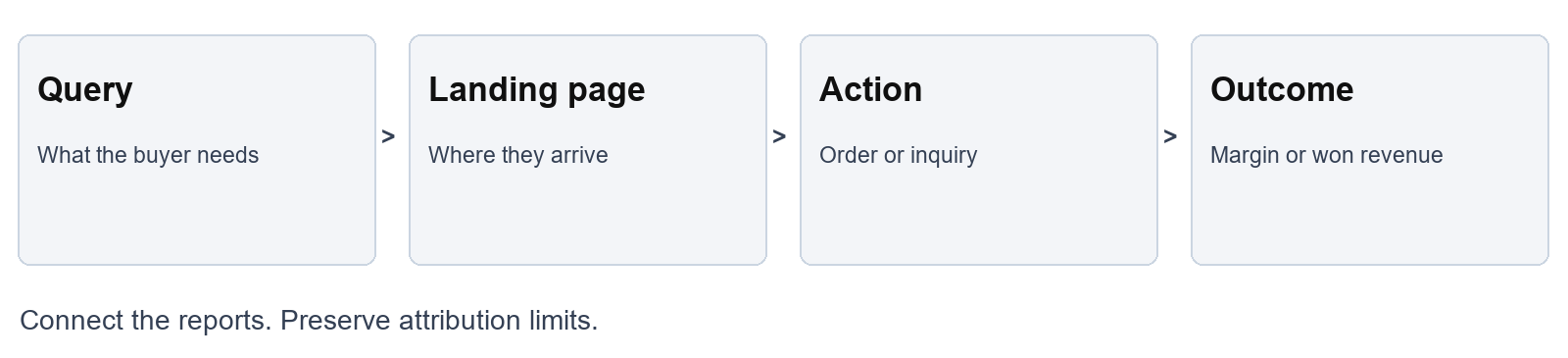
Track each step before crediting traffic growth with commercial impact.



Your SEO, on autopilot
Saffron OS runs 15+ AI agents that audit your visibility across Google, ChatGPT, Gemini and Perplexity every day — then fix what's broken, automatically. Built over 18 months. Results in 2–15 minutes.
Explore Saffron OSFAQs
Is Shopify good for SEO?

It provides useful foundations. Results depend on the catalog, page quality, technical implementation, and competition. Changing platforms alone will not solve an unclear offer or poor product details.
Can I do Shopify SEO without paid apps?
Yes. Many key tasks use native settings and free Google tools. Buy apps or specialist help when the task requires it, not because every checklist includes another subscription.
What is the 80/20 rule for Shopify SEO?
Use it as a prioritization idea, not a proven percentage. Find the small set of pages and defects most likely to affect qualified demand. Start there and inspect the outcome.
How long does Shopify SEO take?
There is no fixed timeline. Indexing fixes, title changes, content development, and authority building move at different speeds. Agree on delivery milestones and review windows instead of a guaranteed ranking date.
Does AI search make Shopify SEO unnecessary?
No. Buyers and search systems still need clear product facts and easy-to-reach pages. Keep the catalog accurate, answer useful questions, and measure the traffic and sales you can observe. Do not replace the fundamentals with an unverified AI visibility score.
Why is organic traffic rising but sales are flat?
Check query intent, geography, stock, mobile experience and tracking. Break results out by landing page. More informational visitors may not create immediate orders, and a broken checkout can erase gains from stronger search visibility.
```

Shreya Debnath

Shreya Debnath is a Marketing Manager at Saffron Edge with over 5 years of experience in SEO, AI-driven marketing, growth marketing, and technical SEO. She has hands-on expertise in optimizing existing content, improving performance, and driving scalable growth through data-backed strategies. She has worked with international markets, especially the US and UK, and diverse teams to build effective marketing campaigns, strengthen brand positioning, and enhance audience engagement across multiple channels. Her approach focuses on aligning sales and marketing to ensure consistent and measurable results. Outside of work, Shreya enjoys exploring new cities, pursuing creative hobbies, and discovering unique stories through travel and local experiences.
Related Blogs
We explore and publish the latest & most underrated content before it becomes a trend.



Subscribe to Saffron Edge Newsletter!


Your SEO, on autopilot
Saffron OS runs 15+ AI agents that audit your visibility across Google, ChatGPT, Gemini and Perplexity every day — then fix what's broken, automatically. Built over 18 months. Results in 2–15 minutes.
Explore Saffron OS