





How to Rank in AI Overviews? 10+ Ranking Factors

01/05/2026

 6 min
6 min
Much advice on ranking in AI Overviews remains assumption-based, but it's clear: now Google is showing AI-generated answers, and the sources in those answers form a new visibility layer.
A March Ahrefs analysis found that 37.1% of pages cited in AI Overviews also ranked in the top 10 of Google. The finding shows substantial overlap between organic rankings and AI Overview citations, but it does not prove that rankings cause citations.
Ranking in an AI overview requires providing material that answers the question clearly, fits search intent, and is organized well enough for Google to retrieve, summarize, and cite.
Google only requires a page to be indexed and eligible for a search snippet. Strong organic rankings may help, but they are not mandatory.
This is a major shift in how businesses gain search exposure. Your content is no longer just fighting for a blue link.
What Is an AI Overview?
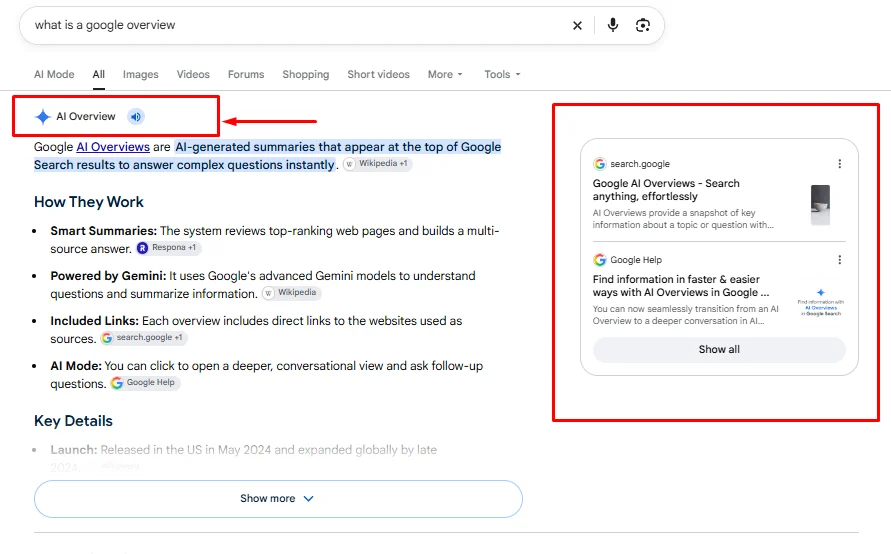
An AI Overview is an AI-generated response that may appear on a Google Search results page. It helps users quickly understand a topic or question and provides links for further explorations.
Google displays an AI Overview when its systems determine that it would add value beyond the standard search results. AI Overviews do not appear for all queries.
Here is how the feature works:
-
Google explores the question: Google explores the question: It may run multiple related searches across different subtopics and data sources.
-
Google may use a technique called query fan-out, which involves running concurrent related searches. Its systems then use relevant retrieved information to develop a response.
-
It displays supporting links: Users can visit those pages to learn more and cross-check important information. The linked pages may answer relevant questions, even if they do not use or rank for the exact wording of the original query.
AI Overviews may appear within standard Google Search results. AI Mode is a separate AI search experience designed for deeper exploration, complex questions, comparisons, and follow-up questions.
Both features can display links, although they may generate different responses and sources. As with any AI-generated answer, AI Overviews can make mistakes or miss context, so users should consult multiple reliable sources when accuracy matters.
How Does Appearing in AI Overviews Help?
When Google cites a page in an AI Overview, it can display a supporting link within or near the generated response. It can introduce your brand while someone researches a topic, though a citation does not guarantee a click or a sale.
1. More Visibility in Search
Your page can appear as a supporting source in the AI answer, in addition to any standard organic listing. It does not need to hold the top organic position for the original query to be cited.
2. A Direct Path to Your Website
People who want more detail can follow the citation to your page. Give them the information promised by the link so they can continue their research.
3. Exposure During Buyer Research
AI overviews can appear when people ask detailed questions or compare options. A relevant citation puts your content in front of them while they are searching for information to make a decision.
4. Visibility for Related Questions
Google may search related subtopics when developing a response. A page may support one of those subtopics even if it does not rank for the exact wording of the original query.
How to Appear in Google AI Overviews: 10 + Factors
Improving visibility in AI Overviews and AI Mode begins with crawlable, indexable pages and helpful, relevant content. The 14 areas below provide practical checks for your site. The 15 areas below turn those priorities into practical checks for your site
1. Googlebot Access and Search Snippet Eligibility
Google needs to reach and index a page before it can show that page as a supporting link in an AI answer. To be eligible, a page must be indexed and eligible to appear with a Search snippet, and the site must be included in Search generative AI features in Search Console. Ensure that Google can crawl and render the page’s important content. Start by checking these settings on the pages you most want people to find.
2. Strength in Google’s Organic Search
Google’s AI search features use its Search index and core ranking systems to find supporting material. That makes established SEO work relevant: useful pages, sound technical setup, and strong organic visibility can help put your content in consideration. An organic ranking, however, does not guarantee a place in an AI response.
3. Relevance to the User’s Question
A page has a better case for inclusion when it resolves the question behind the search. For example, someone comparing two services needs differences, costs, and use cases; a general description of either service may leave the question unanswered. Write for the decision the reader is trying to make.
4. Coverage of Related Fan-Out Queries
Google may use query fan-out, issuing multiple related searches across subtopics before generating a response. Ranking in organic results for those related queries may increase a page’s chance of being used as a source. A comprehensive page can help with related searches, even if it doesn't match the user's exact wording. Cover connected questions where they genuinely help the reader, without producing repetitive pages for every variation.
5. Answer Placement
Answer the question a section raises before adding background or examples. This helps readers find the information they need. In a survey of search professionals, respondents considered answer placement potentially relevant to AI visibility. Google has not published a rule about where an answer must appear on the page.
6. Content Structure for Answer Extraction
Clear headings, purposeful sections, and well-labeled tables make complex information easier to use. Choose the format that fits the material: a comparison may need a table, while a process may need a short sequence of steps. There is no need to split content into tiny blocks solely for AI systems.
7. Verifiable Facts and Supporting Evidence
Support important claims with details, such as measured results, dated findings, product specifications, or a clearly explained method. Cite reliable sources and identify the author when readers would expect to know who produced the information. If you present original research, explain how you reached your findings. These practices help readers check your claims and align with Google’s guidance on helpful content; they are not a confirmed AI Overview ranking factor.
8. Knowledge That Comes From Your Own Work
Original research, firsthand experience, testing, and reporting give a page something other sources cannot simply repeat. A company might publish findings from its customer data, for instance, or explain what it learned while solving a specific problem. The value lies in the evidence and insight, not in labeling the content “original.”
9. A Publisher’s Reputation
Make it easy for readers to identify the organization behind your content and assess its experience with the subject. An accurate About page and a clear record of relevant work can help. Respondents in the same survey considered publisher reputation separately from the quality of an individual page. That is an expert assessment, not a confirmed AI overview ranking factor.
10. Corroboration Across Independent Sources
Independent sources can help verify a specific claim about your business, such as a certification, integration, or product capability. Check that your site, partner documentation, and other reliable records agree on those facts. Experts rated corroboration as influential; Google has not confirmed a citation rule based on the number of sites repeating a claim.
11. Recognition of Your Brand or Entity
Experts also considered whether AI models already have a recognizable picture of a brand, person, or product. That familiarity is difficult to inspect or change quickly. Consistent information and credible coverage may help establish a clearer identity over time, but no brand can assume that a particular mention will change an AI recommendation.
12. Structured Data
Appropriate structured data can help Google identify page details and qualify content for supported search features. Keep it accurate and consistent with what visitors see. Google says AI Overviews and AI Mode require no special schema, so markup should support the page rather than substitute for useful content.
13. Page Experience and Content Rendering
Make sure Google can access the content on your page, including important text loaded with JavaScript. Check that the page also works well on mobile devices and is easy for visitors to use. These are part of Google’s guidance for AI search features.
14. Relevant Images and Video
Add clear, relevant images or videos when they help explain the topic. Google’s AI search features may show this media alongside links to web pages. Google recommends useful, high-quality media but does not require it to be original.
Share


Rank in AI Overviews
Frequently Asked Questions
How does Google decide which sources appear in AI Overviews?

Google’s generative AI features use core search ranking and quality systems to retrieve relevant pages from the search index and ground responses. Google may also use query fan-out to run, which increases your chances of being cited. To be eligible as a supporting link, a page must be indexed, snippet-eligible, compliant with Search policies, and included in Search generative AI features through Search Console.
How are AI overviews different from regular organic search results?
Conventional organic results present ranked links. An AI overview generates a response and displays links to pages that support the information. A page’s presence as a supporting source is therefore different from its numbered organic position, although the same page can appear in both places.
What affects whether a page gets included in an AI Overview?
Inclusion is influenced by relevance to the search intent, clear and useful content, strong topical authority, and overall trust signals. Google is more likely to select pages that directly answer the query and are easy to understand.
Which types of searches usually trigger AI Overviews?
Google says AI Overviews appear when its systems determine that a generative response adds value beyond conventional search results. Triggering varies by query.
How does Google decide how many links to show in an AI Overview for each industry?
Google has not shared a fixed formula for link count by industry. The number of links seems to depend on the query, the depth of information available, and how many sources are needed to support the overview.
Can I stop my site from appearing in AI Overviews?
Google does not provide a separate opt-out specifically for AI Overviews. If a page is indexed and eligible for search snippets, it may be used as a supporting source in an overview.

Nishant Ahlawat

Nishant Ahlawat is a marketing professional with 6+ years of experience specializing in SaaS SEO, content strategy, and go-to-market (GTM) strategies. He has worked extensively with B2B SaaS companies to improve online visibility, build scalable content frameworks, and execute data-driven SEO initiatives. His expertise lies in driving proven results through search optimization, performance tracking, and strategic marketing planning tailored for SaaS growth. Nishant focuses on building and executing marketing strategies that strengthen organic presence, support product-led growth, and deliver measurable business outcomes. Outside of work, Nishant enjoys traveling to offbeat destinations, trekking in the mountains, and exploring local cultures and landscapes.
Related Blogs
We explore and publish the latest & most underrated content before it becomes a trend.




Subscribe to Saffron Edge Newsletter!


Rank in AI Overviews